Tuesday, 27 October 2015

Dave McKean - Talk at the Rye Creative Centre (25/10/2015) updated 28/10/15


**This is a work in progress as you will see as you read further, I shall be completing this post as soon as I can but also adding more bits as my memory gets jogged, feel free to comment or have a look at the rest of the blog**

So on a bright sunny day, I drove through Rye after a wrong turning and over the River Rother to find a building, recently christened Rye Creative Centre, and the venue of a talk by Dave McKean. In the auditorium. Dave was just finishing the connecting his Mac to the projector and then he walked to the grand piano in the corner of the room and started to play. Admittedly I am not too good with recognising some tunes, but I did note that he played Take Five by Dave Brubeck. He then returned to the stage and joked that he did was impersonating Philip Glass, but not a good impersonation., This is the second time I have seen Dave play the piano before a talk and I think it helps to put both the audience and the speaker at ease and possibly more receptive.

Not from Rye, but from Soho, and used for illustrative purposes (Youtube/Garramedia)

After a brief introduction to Dave, by the one of the people from Rye Creative Centre, he started to say that he didn't really know the audience, as they weren't his usual crowds - so he had "packed everything as you don't always know what the weather will be like on your holidays" or words to that effect. He said that he was going to start with his newer stuff and then go back on his past 25 years. So I shall try to emulate that below, enjoy the journey. I have tried to stick to the talk but I have added some useful links.

Recent and Future Projects
  • An Ape's Progress
    • This was piece commissioned by The Manchester Jazz and Literary Festivals
    • Matthew Sweeney - started with The Old Monkey poem 

    • Based around Hogarth's Rake's Progress - An Immigrant's Adventures in Manchester
    • Puppet made by his wife, Clare, 
  • Wolf's Child or Callisto and the Wolves
    • A project from the Wildworks Group (Bill Mitchell), tells of a story about how a girl from a female orientated society ran to the woods, was seduced by a satyr/centaur, protected by wolves and gave birth to a child - this is only the start of the problems.
    • The trailer is seen here.
    • Set at Felbrigg Hall 
The White Ladies (Wolf's Child) - (source)
    • Grow the show, let the show create itself, a dark fairy story (with fairy story colours - black, red and white). 
    • Every night, they took 250 people on a 2 mile hike in the woods
    • Animal nature within us and so it may be a book (film) 
  • Pholk
    • Folk Festivals 
    • Images based on people at Sussex and Kent festivals are less like the ones in Berkshire, people hit each other with metal poles and have stained faces. 
    • (Dave McKean - source)
    • Aren't we all members of different tribes?
  • Wolf's Child film
    • Dave filmed each performance, I think with a Canon EOS 5D (but I could be very wrong), and from various angles including a drone octocopter to get shots from the air - the noise from this drone was talked about at one of the after show talks at Wolf's Child by the Matriarch actress. He is slowly piecing this pieces of art together to form a new film
    • This story is to follow a pregnant girl who runs away from home and somehow gets invited to the show and finds something at the show. 
  • Neon/Moth
    • Dave has been playing with hardware and software associated with virtual reality, Oculus Rift, with goggles and earphones - he was able to fly and draw, by pinching the thumb and forefinger together to create a stylus. Once drawn, he explained how he was able to move within the drawn form. He was very excited by this. The use for artistic self expression, he said, was boundless. A great exploratory space. 
    • Dave talks briefly about Neon Moth in an interview in the Century Guild Book One
  • Nitrate
    • Posters of Silent Movies
    • Dave loves the grammar of film and how it changes in front of your eyes.
    • Murneau, George Méliès, F. W. Murnau's Faust, The Student of Prague by Henrik Galeen to name but a few.
Dave McKean (source) - this image is at the exhibition
in the Rye Creative Centre (until 30/10/2015)
Dave McKean (source)
  • Caligaro
    • This is a relatively new comic project, Dave tells of how being ill when he was a young child and he got into reading through comics. This comic project is based on the film of The Cabinet of Dr. Caligari (1920) - an anarchic script with a sleeping man. A new ending and beginning were added by Robert Wiene that changed the anarchic tones. 
    • Dave's project has changed the ending, but he wouldn't tell us (luckily) and he has set it around Rye. So beware if you upset him in one of Rye's tea rooms, you may end up dead in a page. 
This video (see below), from Word Balloon Moment, tells you a bit more about Caligaro and Nitrate straight from Dave's mouth.


Past Work

  • Berkshire College of Design

    • Learnt about semiotics, signs and signifiers of film.
    • Got paid to do professional work in the evening after a day in the college.
    • Dr. John Leo DeFreitas used to do a talk on everything and Dave loved his enthusiasm, DeFreitas helped curate the art show of Dave's work - Graphicus.
    • A video, by Maria Cabardo, where Dave talks of his at college can be seen here.
    • Nothing was mentioned of Meanwhile.
    • He met up with Neil Gaiman in 1986.
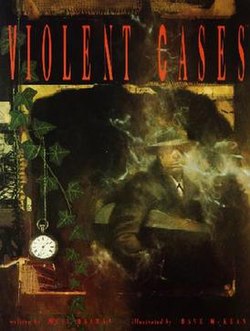
    • Met with Paul Gravett, with Neil, to create a "comic strip/story" for the magazine, Gravett, to his credit, published it as a 44 page graphic novel, the title was Violent Cases. This one book has seven or eight covers (from my memory). There is a good article on this book at Comic Book Resources
Dave McKean (source)
  • Arkham Asylum (1989) 
    • As Dave joins the DC stable of artists, he joins writer Grant Morrison to create Arkham Asylum. This was a golden moment, it has become the most successful comic book ever, at that time. 
    • Dave thinks he may have got the job at DC by Neil being a pushy journalist, but they have been working together for a long time, so something must be working. 
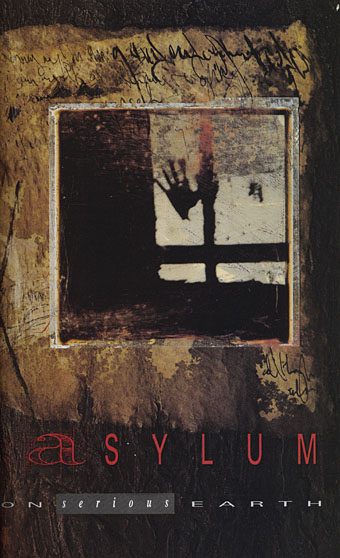
Dave McKean (source - an interesting article by John Coulthart that sources the hand
print from a Mario Bava film from Curse of the Dead)
  • Signal to Noise 
    • Originally commissioned by The Face magazine and then with added pages was published by Gollancz. Paul Gravett talks of it briefly in an article on Dave, see here. Dave didn't say much of it, but showed a couple of images of it. 
Dave McKean (soruce)
    • There is an audio play that was made for the BBC radio network and then it was published both by the BBC and Feral Records. 
    • On the DVD Keanoshow, there is a Signal to Noise short video sampler, this can be partially seen on the show reel of Christian Krupa, see here, about the 30 seconds mark..
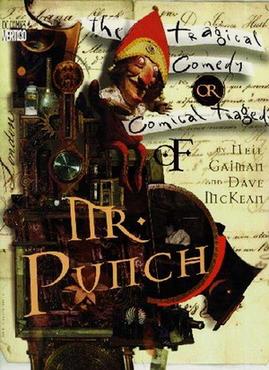
  • Mr. Punch
    • A story about that mixes real life and mixed memories, similar to Violent Cases, and Dave went through all the characters that get killed (the baby, the policeman, etc.) and then ends by saying it is, as we all guessed, a tale of a serial killer. The story ends on a high note when all the people are killed, Mr. Punch is allowed to spread his cheer around the land. 
Dave McKean (source)
    • Green Man Review has reviewed the graphic novel here and the radio play here
  • Cages
    • This is a collection of stories in one long book. There are stories on the nature of belief and creation myths. It is good to see that both the cat and the man as well as the creation myths make a welcome return in Pictures That Tick Volume Two.
    • It has memorable characters such as the man with his words, the two removal men, Angel the musician. Great scenes that mirror life such as the joke telling at the Jazz club, that don't mirror life where a man talks with a cat both supported by clouds. 
    • Dave said that he didn't really like drawing superheroes in odd poses with capes billowing in the wind, but liked adding pauses, real life people. 
    • After Book or Chapter 3, he got a letter saying that the reader knew what Dave was doing, so with great Dave'ness he add a non sequential part, the girl in the woods section. That stopped the letters, that pleased Dave. 
Dave McKean (source)

    • Time published an article on Cages, here it is. 
  • Covers
    • Probably how we first heard of Dave's work, he quickly flicked through a few early covers and then a couple of covers from The Sandman Overture. 
    • Have a look at the book Dream Covers. He did say, at the beginning of the talk that he prefers to talk more about his current projects than his past work. He wrote something similar to this in the recent book Dream States.
    Dave McKean (source)
    Dave McKean (source)
    • Neil's story of the fish that is shown in Dream States is based upon his trip to the refugee camps. 
    • Dave like machine more than computers; as computers don't play with you whereas with machines you can press lots of buttons and shine lights in them and then produce something, saying (if they could) "Is this what you wanted?"
  • Father's Story
  • Creation Myths
  • Black Holes
  • 40th Birthday
  • The Coast Road
  • The Rut
  • The Blue Tree
  • John Cale - What's Welsh for Zen
  • Celluloid
    • Sex is fun, its okay. Dave doesn't really like violence. So he made a book for your brown paper bag. One person did bring a copy to sign and Dave did mention the aforementioned bag. There is a video of some of the pages from the book on this Fantagraphics page. Century Guild does a review of the book here.
  • Smoke & Mirrors
    • Illustrations
    • Exhibitions
      • Rye Art Gallery - a few images were shown at The Blue Tree Exhibition, including one of the stag and the photographer. 
  • Heston Blumenthal work
    • The Fat Duck Cook Book
    • Historic Heston
    • Restaurant Murals
    • Website
    • Restaurant Based Art Work
  • Short Stories
  • Bob Dylan
    • Desolation Row
    • Mojo Magazine illustration 2015
  • Iain Sinclair
    • London Orbital
    • Book Covers
    • Talk at The Horse Hospital, 2014
  • A Clockwork Orange
  • Comics Unmasked
    • Podcast by Alex Fitch
  • Terror & Wonder
    • The poster
    • The art of gothic album covers
  • Record/CD Covers
    • Counting Crows
    • Dreamtheatre
    • Buckethead
    • Michael Nyman
    • John Cale
    • Frontline Assembly
    • Black Waterside
    • Feral
  • Feral Records
  • Monographs
    • A Book of Black and White Lies
    • Option Click 
    • The Particle Tarot Major
    • The Particle Tarot Minor
  • Sketchbook Series
    • Cities
    • Squink
  • Children's Books
    • Goldfish
    • Wolves
    • Crazy Hair 
    • Coraline
    • Graveyard Book
  • Homecoming and Ray Bradbury
  • David Almond
    • The Savage
    • Slog's Dad
    • Mouse, Bird, Snake, Wolf
  • S.F. Said
    • Varjak Paw
    • Varjak Paw, the Outlaw
    • Phoenix
  • Dawkins
  • Harry Potter
  • Films
    • The Week Before
    • Neon
    • Displacements
    • Whack!
    • Mirrormask
    • Gospel of Us
    • Luna
    • 9 Lives
  • Questions answered at the end
    • Drawer's Block
    • Do you dream a lot
    • Working with S. F. Said
    • Look for things before coming involved in projects
  • Awards

  • Frequently Asked Questions
    • Have a look at the FAQ on Dave's website.
  • Biography 
    • Have a look at his biography on his website.

Friday, 1 May 2015

I is for Imagination - what is it and where does it come from

"The ability to form new images and sensations
in the mind that are not perceived through 
senses such as sight, hearing, or other senses."
This is what imagination is according to Wikipedia.

Source 
And it is a good definition. 
This intangible concept helps the 
creative to hone their craft. 
But where does it come from?

Alex Schlegel, graduate student from Dartmouth College
that the concept of imagination comes from the 
"brain's 'mental workspace',
a widespread neural network that coordinates activity 
across several regions in the brain
and consciously manipulates symbols,
images and theories."

To prove where imagination is occurring in the brain, 
Schlegel asked participants in the study to imagine a bee's body
with a bull's head. 

Google for all it's good cannot provide me with this image, 
see here. But as I type this, my mind is already forming that image. 

The participants, whilst imagining this and other creative thoughts
had their mind read by a functional Magnetic Resonance Imaging instrument (fMRI). 
The fMRI looks at the metabolic functioning of the brain 
whereas an MRI instrument just looks at the anatomical structure. 

 The results being that the visual cortex is 'actively involved' 
as are other areas of the brain. 

Credit: Alex Schlegel

From my limited brain anatomy knowledge, the other areas that are involved
include occipital lobe, cerebrum, posterior parietal cortex,
 thalamus, medial temporal lobe,
frontal eye fields, dorsolateral prefrontal cortex,
supplementary eye field and magnetic field correlation.
(Sadly I don't know or can find PCU, PITC and FO - help me out). 
So may be imagination is greater 


you could always add your own...


Thursday, 30 April 2015

H is for Here - Richard McGuire

How often do you come across
a graphic novel 
that has taken 15 years to create?

Source

This year, 
McGuire released a hardcover book
of three hundred and twenty pages 
that pictorially described 
a plot of land
no bigger than your front room 
or living room over a 
long period of time.

Source
Chris Ware, writing in the Guardian, describes Here as:
"...the corner of a room from a fixed viewpoint, 
projecting a parade of moments, holidays, people, animals, biology, geology
- everything, it seems, that defines life and lends human life meaning - on to windows of 
space labelled by year (1971, 1957, 1999, 100,097 BC)..."

It started off, as Mr. ware describes, as a six page story 
in RAW volume 2 number 1 in 1989. 
The chronology ranges from 500,957,406,073 BCE to 2033 CE
but not necessarily in the right order.
Source
Also the spine of the book acts as the corner of the room, 
I urge you to get it. 
Not only is it a graphic novel of great intellect, 
it combines history, architecture, environment, 
examples of society and diet (to name only a few themes)
- it also gives you time to mull over a great exhibition. 
All of these pages could easily be hung in a gallery. 
Don't trust me, have a listen to 
a podcast here.

Tuesday, 28 April 2015

G is for Goya, War, the Chapman Brothers and Barron Storey

Goya,
Francisco Jose de Goya Lucientes
born on the 30th of March 1746
in Fuendetodos, Aragon, Spain
and died from a stroke at 82
in Bordeaux on the 16th of April 1828.

Source

Add caption
He was court painter to the Spanish Royal Family,
he also documented the short and long term effects of
the Peninsular War (1808-1814)
as well as the Dos de Mayo Uprising.
This series of aquatint illustrations
was entitled
"Desastres de la Guerra" (1812-1815)


Plate 3 - Source

It took 35 years for the collection of illustrations
of Goya's Disasters of War to be published due to
its criticism of the French and the Bourbons.

The plates are divided into three sections:
Plates 1 - 47 - Incidents and results of war on civilians and military personnel
Plates 48 - 64 - Effects of famine in Madrid (1811-1812)
Plates 65 - 80 - Thoughts of the liberals once the Bourbon Monarchy had been restored

Plate 71 - Against the Common Good - Source
A collection of the plates can be seen here.

The Chapman Brothers added their own perspective 
to a mint condition portfolio by adding 
either clown or puppy heads to the faces on the prints.

Source
 In an addendum to this recordings of genocide, 
the artist Barron Storey created an updated version. 
Black Iraq - where he tried to draw and paint every person
that died in the Iraq War. 
The exhibition can be seen here.

Source 

No doubt, this blog will revisit war.

Monday, 27 April 2015

Our Chosen Instrument - #14 - Luke Brabants

Luke Brabants is an artist 
based in the South East of England 
in the depths of East Sussex. 
His rural roots are often reflected
in his art work.


Luke includes Benji Davies as well as the work of graffiti artists including 
Smug1, Etam Cru, Dank, and his friends including
 Morgan Davy and Atom as his inspirations. 
He also finds inspiration from Norman Rockwell. 


His styles often change as do his inspirations
but he thinks that his work at the moment reflects his
mural and street art background. 
He has been painting professionally for 12 years
and although finances have constrained his career, 
he wouldn't change it for the world. 
He feels that he is getting a greater reputation 
as time goes by and with clients such as Hilton, RedBull and Samsung. 
One would agree with that. 


Luke is currently working on some personal projects including
the writing and illustrating of his first picture book, 


He also runs an outdoor art centre for people
to try their hand at spray painting
as well as other outdoor art. 
Have a look here.

He can be contacted through his website, Facebook and Twitter.

Tuesday, 14 April 2015

F is for Frazetta - Part One

Frank Fraz(z)etta
dropped the second 'z" to avoid 
the clumsiness of the spelling. 
But his artwork was less than clumsy. 
Born on the 9th of February 1928, 
his early art attempts at the age of two
were encouraged by his grandmother. 

This led to Frank attending the 
at eight years old. 
He was "taught" by tutor Michael Falanga,
but it was more a question of encouraging 
and suggesting different approaches. 
By sixteen, Frank had worked on 
cleaning pencil work and inking,
before working at Standard Comics
with Graham Ingels in 1947. 

By the early 1950's,
Frazetta had worked for EC Comics

Source

A chance glimpse of one of his pieces
for Mad Magazine with a spoof shampoo advert
lead to him being hired by United Artists for 
the movie posters for 
both images.

Source

The introduction of movie poster illustration led to
the creation of covers for Fantasy and Science Fiction literature. 
More to follow...soon

Tuesday, 7 April 2015

E is for Eisner - Will not Michael

Died in January 2005, 
but so famous within the comic world
that he set up awards for the industry.

Source
William Erwin Eisner
was born in March 1917
and by 1940 was drawing the
comic stories that he would
be remembered for all time.

The Spirit
Source

In 1936, Will was high school friends
with Bob Kane, the creator of Batman,
and Kane suggested that Will draw
for Wow, What a Magazine.
This led to various comic stories.
It also led to Eisner
keeping copyright ownership of
"The Spirit".

When asked if his character was a superhero,
Eisner drew on a mask around the eyes.
Source

He also had fun by combining
the title's name within the
architecture in the comic panel. 
Source
Eisner was also one of the artists used by the US Military
to create comics to train the Army
on the intricacies of M16 weaponry.

Source

Eisner later founded
the American Visuals Corporation
producing manuals for the government backed bodies.
Source

Eisner continued to play or experiment with the art,
formed what later would be called graphic novels
such as The Contract with God.
Often pages of art with no dialogue
were able to show such depths of emotion.
Source

Have a look at the links and no doubt,
I shall return to this posting to add more about
Will Eisner. 

Monday, 6 April 2015

D is for Drawn Disney - the nine old men


I must apologise.
I like Disney cartoons, 
be they short or feature length. 
But I prefer the ones
that don't contain computer generated imagery.

King Louis from The Jungle Book - Source

Maybe it is the drawn lines
combined with the expanses of plain colour.

The smooth and realistic movement
that reflected "the illusion of life".

Or is it the combined work of a collection
of the old nine men?
The name given to the core animators
from the 1930's to the mid 1970s.


The Nine Old Men - Source
Alphabetically, and not working from the image above,
I am not doing all the work for you. they are Les Clark,
Marc Davis, Ollie Johnston, Milt Kahl, Ward Kimball, Eric Larson,
John Lounsbery, Wolfgang Reitherman and Frank Thomas.

Les Clark, died in September 1979, was known for animating
Mickey Mouse as well some of the first feature-length animated films.

Source

Marc Davis, died in January 2000, cut his teeth on Snow White
and worked on the villains in Sleeping Beauty and 101 Dalmatians.
His work was also used in the Imagineering Department
with the Pirates of the Caribbean and the Haunted Mansion.

Source
Ollie Johnston, died in April 2008, was one of the authors
of The Illusion of Life, animated Smee in Peter Pan,
Cinderella's stepsisters to name but two (or three).

Source
Milt Kahl, died in April 1987, worked on Shere Khan in The Jungle Book
and Madame Medusa in The Rescuers to name but two..

Source

Ward Kimball, died in July 2002, was a joker
and used his life experiences to animate Jiminy Cricket and the Cheshire Cat
as well as many others. 
Source

Eric Larson, died in October 1988, animated the Beatle'esque Vultures
from The Jungle Book but also helped to teach the next
generation of Disney Artists.

Source

John Lounsbery, died in February 1976, was known for
his squashed and stretched animation and created the
animation of the elephants in The Jungle Book.

Source

Wolfgang 'Woolie' Reitherman, died in May 1985,
animated Monstro in Pinocchio and the Crocodile in Peter Pan.

Source

Frank Thomas, died in September 2004, was the co-author with
Ollie Johnston and also collated a collection of sight gags
entitled "Too Funny For Words".

Source

The Nine Old Men produced an elastic set
of rules for animation, these included:
1) Squash and stretch
2) Anti-ci-pation
3) Staging
4) Straight Ahead Action and Pose to Pose
5) Follow Through and Overlapping Action
6) Slow In and Slow Out
7) Arcs
8) Secondary Action
9) ...Timing
10) Exageration
11) Solid Drawing
12) Appeal

Here is the first video of
the 12 Principles of Animation.
Source

A good summary of this page can be found here

Sunday, 5 April 2015

C is for Crowd Control

Crowds and numbers of elements when shot on film, 
be it the can or within a render farm, 
have to be controlled. 

This post looks at some of the 
more populated films and the
techniques needed to wrangle the
crowds.

has recorded the numbers
within crowds for the earlier films
on their blog post here.  

included a crowd scene with over 3,500 extras. 
(Youtube.com) 


Friz Lang's Metropolis from 1927
included 38,000 people. 
(Youtube.com)

Look at the title scene of 101 Dalmatians
for managing 
and animating the dots. 
Xerography certainly helped the process, 
despite Walt Disney allegedly stating that 
he disliked "the rough drawing style
brought about by the Xerography process". (IMDB)
(YouTube.com)

The dots have been counted - 6,469,952 dots in the whole film.


In 1994, an original story partially based on a Shakespeare play
gave the public The Lion King.
Within this film, the alpha lion Mufasa
has to be eliminated by the usurper Scar.
What better way to do this in Africa than
with a wildebeest stampede.

Source

IMDB.com states "The wildebeest stampeded took Disney's CG department approximately three years to animate. A new computer program had to be written for the CG wildebeest stampede that allowed hundreds of computer generated animals to run but without colliding into each other." The coloured wildebeest denote the characters with certain movements or behavioural traits. 
(Youtube.com)

In 1996, another Disney film, 
The Hunchback of Notre Dame, 
used crowd simulation for a scene 
where we see the crowds in the square below
during the song The Bells of Notre Dame.
 
(Around the 3.55 minute mark, the crowd appears - YouTube.com)

This should give you enough to get on with, but I shall be adding to this blog post with the use of the crowd simulator from Weta Digital. Happy Easter, oops, this dates the blog post. 


Friday, 3 April 2015

B is for Berkeley Breathed

Guy Berkeley Breathed is a man who reintroduced the comic strip in the 1980's by combining comments on society, politics and American life with the inclusion of bizarre but beautifully crafted characters. 
He also used his own experiences to add life and plot to the cartoon strip.

Have a look at either Bloom County, Outland or Opus.

What do you get if you cross a penguin with a tie, shirt collar, trainers and a humungous nose?
Add to that a ginger cat that looks like it has just eaten some space dust. 
Finally a purple cockroach that wears a bowler hat.

Source

It reminds me of Pogo by Walt Kelly
although I did come to this after Mr. Breathed; 
it combines socio-political commentary 
from swamp critters. 

Source

It could be said that Liberty Meadows by Frank Cho 
was the successor to both Kelly and Breathed. 
He combines the anthropomorphic animals 
set in an animal clinic with the vet and nurses
dealing with their own relationships. 

Source

So why do artists use animals or anthropomorphic forms
within comic strips that comment on society and politics?
TBH (to be honest), I don't know
but I presume it may have something with it
being easier to access something that looks like
a comic strip but putting a very strong message across.

Spitting Image,
the satirical puppet show
on British television
didn't hide behind animals in
such the ways illustrated above.
Peter Fluck and Roger Law created
the cast of latex caricatures to
wreak havoc on a Sunday evening.

Source


I am sure there are people and readers, out there, 
who know a better way of putting this across. 


Wednesday, 1 April 2015

A is for April Fool


The first of April is one 
of the Creative's better days 
be it for fun or 
just to hype a brand.

Here is a pick of this
year's crop. 

Clear Marmite
Source

The Force is found at Cern,
a great article with some clever references
including these are not the droids you are looking for!

The RNIB
releases CatNav
for the Blind

 
RNIB


Playstation Flow
immersive gameplay 
(YouTube & Playstation)

Amazon Dash
the button
(Youtube & Amazon)

And not forgetting 
(was this not a subtle advert for 
a film called Pixels?)

What did I miss out?